Newsletter of the ACM Special Interest Group on Genetic and Evolutionary Computation
Table of Contents
Editorial
Welcome to the 2nd (Summer) 2026 issue of the SIGEvolution newsletter! This issue is dedicated to the memory of Günter Rudolph, who sadly passed away on May 24th, 2026, after a short stay in hospital. Günter Rudolph advanced evolutionary algorithms through rigorous, scientifically sound and internationally recognized research. His interdisciplinary work in music informatics merged computational science with aesthetics, beautifully illustrating his scientific openness and intellectual curiosity. As the tributes in this issue confirm, Günter was a dedicated and approachable mentor who championed interdisciplinary research and guided numerous careers. His global impact was recently recognized with the prestigious IEEE Evolutionary Computation Pioneer Award. The evolutionary computation community loses an outstanding pioneer, dedicated mentor, and valued colleague whose legacy will endure.
The next article reviews recent search use and performance of the online genetic programming bibliography. We continue with a summary of a PhD dissertation on the difficult topic of understanding and visualising population dynamics in evolutionary algorithms. We conclude with the usual announcements and forthcoming events.
Tributes to Günter Rudolph (1963-2026)
Thomas Bäck, Roman Kalkreuth, Oliver Kramer, Frank Neumann, Heike Trautmann, Vanessa Volz
This article collects tributes to Günter Rudolph sent by members of our community, listed in alphabetical order. Additional tributes have been collected by his family at: https://www.forevermissed.com/guenter-rudolph/about

Thomas Bäck
With great sadness, I learned of the passing of Günter Rudolph, and I remember well the moment on that evening of Pentecost Monday, 2026, when I heard the sad news.
Günter and I both pursued our doctoral studies in the 1990s under the supervision of Professor Hans-Paul Schwefel, during an exciting and formative period for evolutionary computation and evolutionary strategies. We both had a lot of fun together, in a truly exciting phase of the field in which it started to gain a lot of international recognition and attention. Günter was one of the researchers who gave that research its distinctive character through his clarity of thought, analytical depth, and determination.
His scientific contributions to evolutionary computation and to the theoretical foundations of evolutionary algorithms have shaped the theoretical understanding of our field significantly. His early work on global convergence and integer search spaces, proposing an evolutionary algorithm for such a type of problem, has started a whole new research direction for analyzing evolutionary algorithms. I warmly remember our wonderful experiences in the 90s, visiting conferences such as PPSN 1990, 1992, and 1994 together, as well as other meetings such as the ICGA, GECCO, and CEC conferences. Just recently, in Hangzhou at CEC 2025, I had the pleasure of being with him when he received the very much deserved IEEE CIS Evolutionary Computation Pioneer Award for his achievements in the theoretical analysis of evolutionary algorithms.
I did not know then that it would be one of the last few times that I would have the pleasure to be with him, talk to him, discuss a few plans for future collaboration (I am glad we still had the chance to write a paper together after that), and enjoy a few nice dinners and a beer with him.
I remember him as a colleague and a friend from our early PhD days together (including our activities supporting the organization of PPSN I, in Dortmund in 1990). I recall the many conversations, the conferences we attended, the stimulating scientific discussions, and also the funny moments when his very dry humor showed up.
His passing leaves a great void, both scientifically and personally. I will remember him as a valued colleague, a companion from the early years of our field, and a person to whom I felt a genuine friendship and professional bond. I will always cherish these memories, Günter!

Roman Kalkreuth
I first met Günter Rudolph in 2012 at TU Dortmund University when I started looking for a PhD supervisor. We established more contact on a regular basis after I presented the outcome of my master’s thesis at the Computational Intelligence Workshop in Dortmund in the same year.
Back then, people in German academia sometimes still distinguished between graduates from a regular university and a so-called university of applied sciences, or “Fachhochschule” in German, since the traditional diploma degree earned at a regular university was considered to be a higher, more substantial, academic degree. This was particularly evident when considering an academic career and applying for a PhD position, even though the introduction of Bachelor’s and Master’s degrees in Germany had already standardised qualifications in computer science.
Günter did not distinguish between them. He stood for the genuine values of fairness and equal opportunities. He was open-minded and already collaborated with my Fachhochschule, the Southern Westphalia University of Applied Sciences in Germany, when I was still enrolled in the master’s course there. I was very happy when he accepted me as a PhD student and offered me the opportunity to join his research group, although I had great respect for him, as his reputation and academic standing were already outstanding.
What impressed me most about Günter’s expertise was the wide range of his scientific portfolio. He was one of the first to conduct mathematical runtime analyses of evolutionary algorithms and received the IEEE Computational Intelligence Society Pioneer Award in recognition of these works last year. The theoretical analysis of optimisation algorithms was therefore a key focus of his research, but he also considered a broad empirical portfolio from computational intelligence methodology, particularly in the context of interdisciplinary research in music and games.
Günter was a great mentor for me personally, and I am grateful for everything I have learned from him. I was fortunate enough to do my PhD under his supervision. His approach to science, feedback, and encouragement have had a profound impact on my career and work. The time I spent in his research group at TU Dortmund University was a precious and formative period, which I like to look back on. Our community has lost an outstanding scientist, a brilliant mind, and a valued colleague who undoubtedly leaves a pioneering legacy. He will be greatly missed.

Oliver Kramer
Günter was a top scientist, a wonderful theoretician who could explain even complex matters in a simple way, but also a very good experimental researcher.
He was a great boss. It was great fun to work with him. We, his employees, called ourselves “the pack” (“das Rudel”) at the time, in reference to his name. During this period, we organized PPSN X 2008 and wrote one or another paper together. There could easily have been more.
In 2013, Günter was part of my habilitation committee at the University of Oldenburg, when I was still a junior professor, and most recently, in 2023, he was an external committee member for a PhD thesis in my department. He was always fair and in a good mood, a truly kind soul. We shared one or another view on things as well as interests, for example, the Caribbean as a holiday destination.
Alongside Prof. Hans-Paul Schwefel from TU Dortmund and Prof. Ipke Wachsmuth from Bielefeld University, Günter is one of my three role models in science. Especially in a difficult time for science, in the age of so-called science management, Günter stood out through competence and genuine passion for his and our topics.
Whenever I knew that I would meet Günter at a conference, I always looked forward to that conference in particular, and I enjoyed philosophizing with him in the evening over a cold drink about evolution strategies and all sorts of things. It is also wonderful that, most recently, and this can only benefit the AI community, he published not only at our home conferences GECCO, CEC and the like, but also at AAAI.
I will always remember how Günter answered my question, this must have been in 2008 or 2009, whether he could imagine leaving Dortmund once again for a professorship somewhere else: “Never, only for a W3 professorship in evolution strategies on Mallorca.”
We will miss Günter very much. In memory of the person he was, and in gratitude for his contributions to the field of evolution strategies.

Frank Neumann
Günter Rudolph has been an amazing person and colleague who made very significant contributions to the evolutionary computation community. PPSN 2008 and 2022, which he organised with his team in Dortmund, were two very memorable conferences with a very strong scientific and social program.
From our research interactions, especially during his visits to our group in Adelaide in 2019 and 2024, I remember Günter as someone deeply thinking about new problems and setting new directions within the theory of evolutionary computation.
I have known Günter for about 20 years and first came across his work while I was doing my PhD. Günter’s PhD thesis, published 30 years ago, can be seen as the blueprint that led to the creation of the area of runtime analysis. Indeed, a lot of runtime analysis work done in the late 1990s and early 2000s builds on Günter’s PhD thesis. The foundational contributions he made in his thesis have been honoured at a PPSN workshop called ‘25 Years of LeadingOnes (and Other Great Ideas)’ in Dortmund in 2022. I still remember that Günter was initially very reluctant to listen to all our praise of his excellent contributions. So, people had to persuade him to attend and hear all the good things the speakers had to say about his amazing and high-impact work. Günter’s contributions to theory have been further honoured by the IEEE Pioneer Award 2025. He used his “Pioneer talk” to show the impacts of theoretical contributions and clearly pointed out the value it brings to applications.
Our community has lost one of its pioneers, but his contributions and our memories will continue to live on.

Heike Trautmann
Günter accompanied me throughout my entire academic career, and without him I would certainly not be where I am today.
Curiously enough, I first met him and his research group at my very first conference, the CEC 2007 in Singapore. Although we were both working at TU Dortmund at the time and had our offices only a few hundred metres apart in different buildings, we had never met before. This was probably because I was still affiliated with the Department of Statistics, where I was working on my habilitation, albeit on a topic in multi-objective optimization.
Shortly after Singapore, however, I gradually became part of his research group, and it was largely thanks to Günter that I eventually found my academic home in computer science, and in particular in the field of Evolutionary Computation.
In 2017, we co-organized the EMO Conference in Münster, a memorable experience that reflected Günter’s ability to bring people and ideas together. Equally unforgettable are our joint research visits to CINVESTAV and Oliver Schütze in Mexico. It was there that I shared many wonderful moments with Günter, including smoking my first—and, as it turned out, my last—cigars.
Beyond his outstanding scientific achievements, Günter was a mentor, a colleague, and a friend whose generosity, warmth, and enthusiasm shaped the careers and lives of many around him. I am deeply grateful for his guidance, his trust, and the many experiences we shared.
Günter, I will always cherish those memories. You will be greatly missed.

Vanessa Volz
Günter was my PhD supervisor and later a good colleague. He hired me after I sent him a cold email, despite me not having any previous knowledge of evolutionary computation. Taking a chance on me opened the door to academia in general and EC in particular, for which I remain immensely grateful.
When working with him, I always appreciated the way he reacted to contributions from everyone, no matter their background or seniority. While he examined all ideas critically, he genuinely took the time to consider each one. This was especially valuable for a young PhD student just starting out, giving me the confidence to explore ideas independently.
It was only much later that I began to understand the scientific impact he has had on evolutionary computation as a field. Günter had broad interests, including (multi-objective) applications in games and music, which is why I initially overlooked his pioneering contributions to the theory of evolutionary computation. I believe his ideas and more recent projects will continue to impact research for years to come.
Beyond his work, Günter was always up for a chat about his many travels and a beer. Günter, you will be sorely missed at the next “Stammtisch” and during book project meetings. I hope we do you proud.
Who Found What: Searches of the Genetic Programming Bibliography
W. B. Langdon
Abstract
The genetic programming bibliography keyword search has been used hundreds of times, with an average response time of 21 milliseconds and more than 10,000 GP papers found. We summarise recent queries, top GP papers retrieved, user devices, and updates to the bibliography.
Background
The Genetic Programming bibliography aims to cover all papers, books, PhD theses, etc., on genetic programming. It was started by John Koza and first published in 1994 as Appendix F of his second GP book [1], with an expanded version as Appendix B in Advances in GP 2 [2]. It is now fully online and hosted by the Computer Science department of University College, London (UCL) http://gpbib.cs.ucl.ac.uk, with an automated mirror hosted by the Perelman School of Medicine in the University of Pennsylvania http://gpbib.pmacs.upenn.edu.
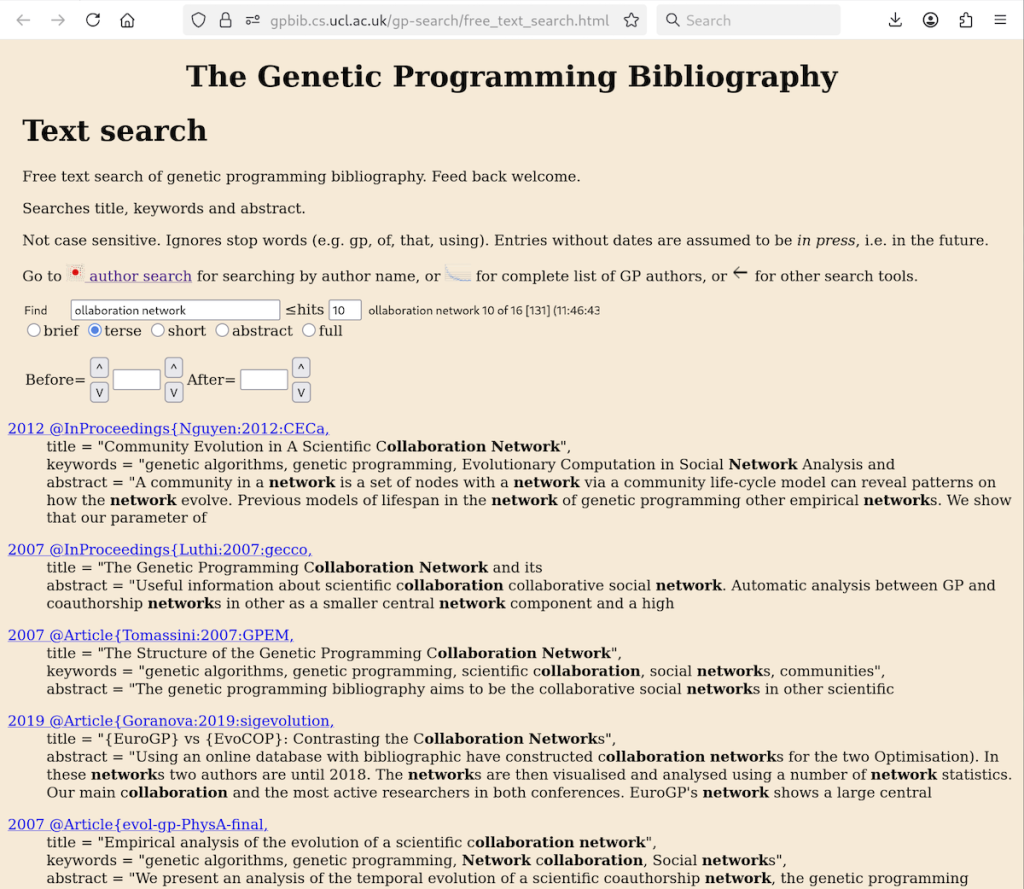
Two years ago, the then-new search interface of the bibliography was described in the ACM SIGEVOlution newsletter [3]. This article reviews the recent use and performance of this search method (Figure 1), which departs from early server-side and syntax-based database approaches by running locally on the user’s browser or smartphone and offering free-text search.
A longer version of this article is available via http://www.cs.ucl.ac.uk/staff/W.Langdon/ftp/papers/langdon_2026_sigevolution_long.pdf
This extended version gives more information on user queries (Sect. 4), some limitations (Sect. 6), changes since [3] (Sect. 7), and an additional graph showing that the popularity of papers approximately fits a power law.
Usage of Keyword Search
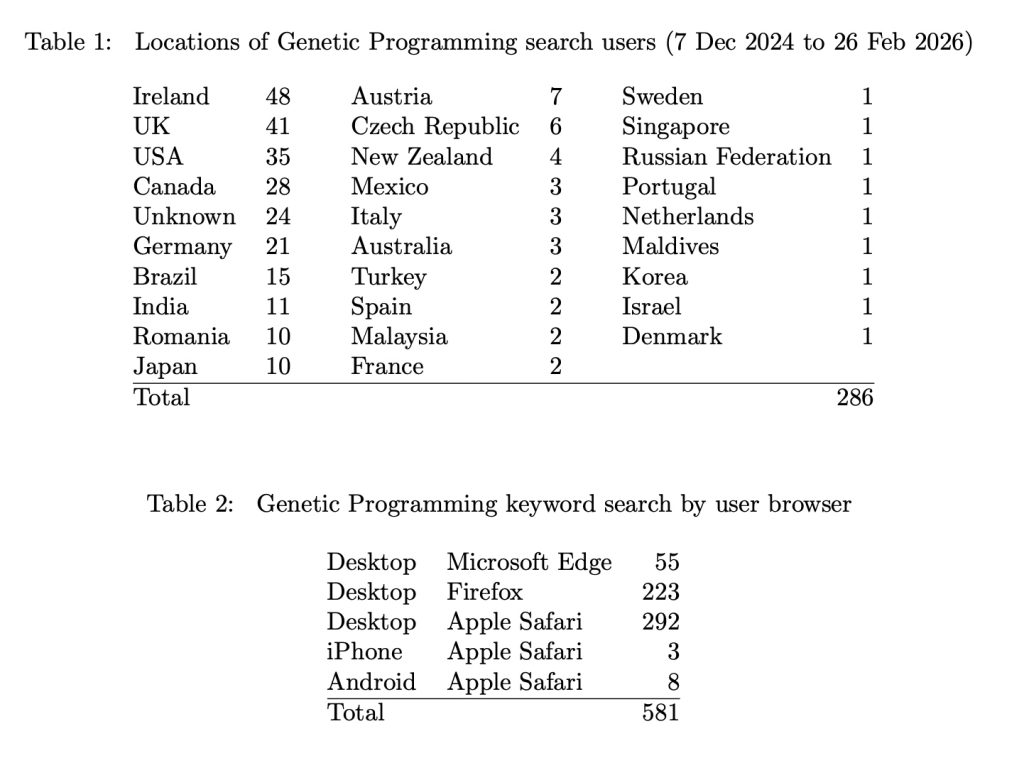
Although free text search can be used offline (and indeed via the University of Pennsylvania mirror), we report usage based on the data logged at UCL, feeling that this will give a reasonable indication. Due to upgrades, we present data from the end of December 2024 onwards. Table 1 shows that the search facility has been used several hundred times from across the world, notably from Ireland, Europe, and North America. So far, three types of browsers have been used for GP keyword searches. Table 2 shows that Apple’s Safari web browser is the most common (52%), with Firefox almost as popular (38%), followed by Microsoft’s Edge web browser (9%). Less than 2% of queries are run from the user’s smartphone.
Usage of Options
Figure 1 shows the user interface allows people to: alter the number of matches displayed (hits), select one of five display modes, and choose the papers to be displayed by their publication date (e.g., “Before” 2010 and “After” 2000, i.e., during 2000–2010, inclusive). Notice that if “Before” and “After” are set to the same value, only matching papers from that year are displayed. The central up or down arrow buttons can be used to simultaneously change both before and after years, allowing easy scrolling through multiple matches according to which year they came out.
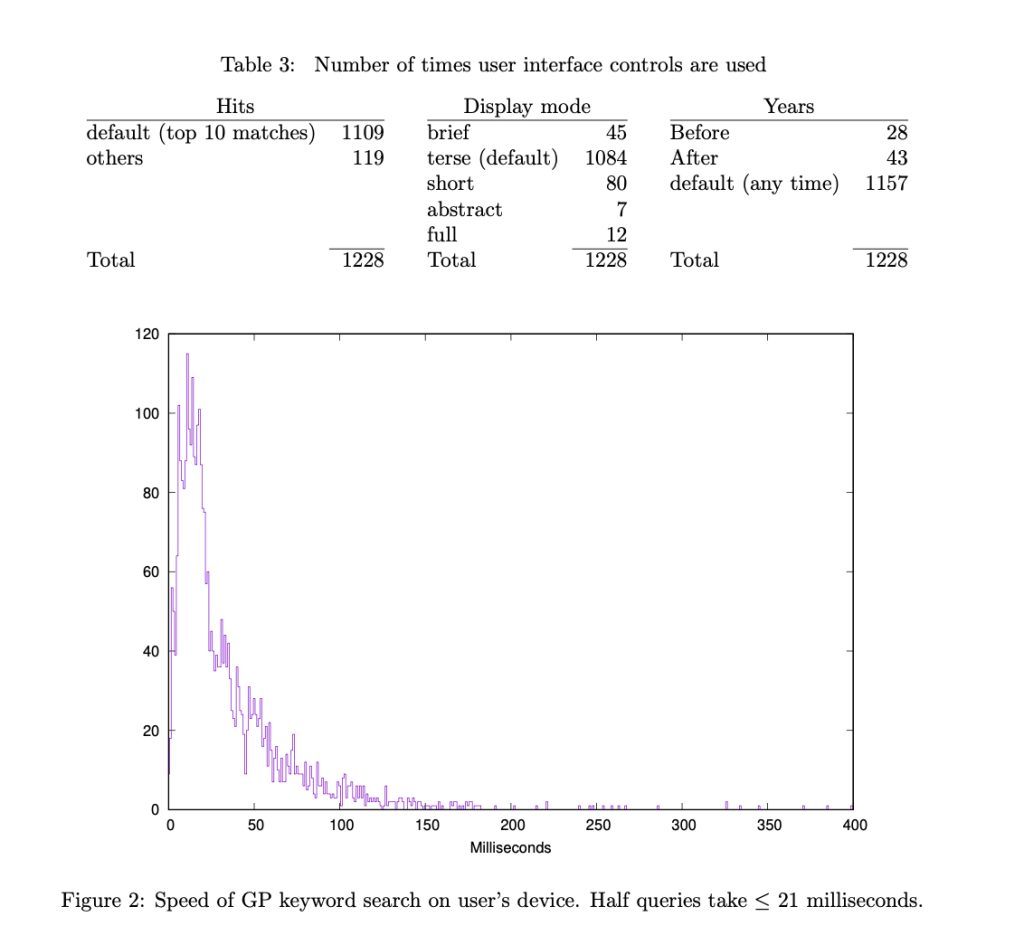
Table 3 shows that almost all people used the default settings. However, in 10% of queries, the maximum number of matching GP papers (“Hits”) was changed from its default value (ten), typically to its maximum value (100).
Similarly, the results of all but 12% of queries were displayed in the default mode (“terse”). The “brief” mode can be used standalone, i.e., without connection to UCL, and so may not be logged. Nevertheless, Table 3 shows that (when it is logged) it accounts for less than 4% of queries. The “abstract” display mode (which is like “full” but only shows the matching title, keywords, and abstract) was recently added in response to a user request. Since it has been available for less time than the other display modes, this may in part explain why it is only used in half a percent of queries. However, the logs continue to show a very strong preference for users to accept the defaults.
Performance
Figure 2 shows that search is effectively instantaneous (median response is 21 milliseconds). As expected, the distribution of search times has a long tail; nevertheless, 95% of searches complete within 1/10th of a second. Figure 2 shows the speed recorded by the user’s device and includes the time to update the search interface’s own display (upper part of Figure 1). Except for the “brief” display option, Figure 2 does not include the time to fetch and display results across the Internet. From the Apache logs, it seems fetching the result web pages typically takes less than a second.
Since the “brief” option does not rely on immediate response across the Internet, as well as giving compact answers, it might also be a useful option on slow connections.
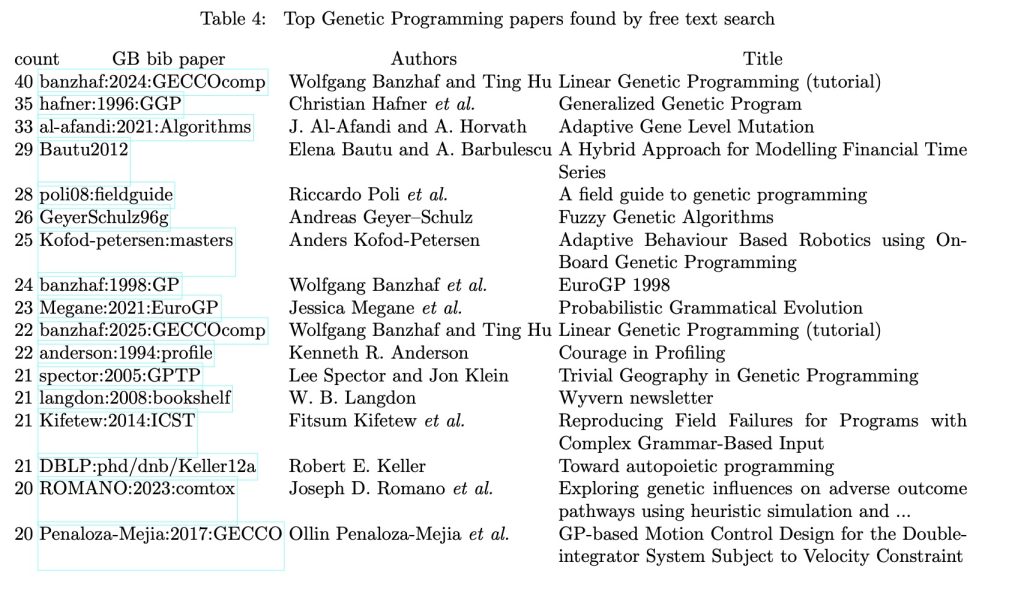
Putting aside the problem that the logs cannot be complete, from 7 Dec 2024 to 26 Feb 2026, some 10,290 Genetic Programming papers have been found. As expected, a few are much more common than others, and there is a long tail. For example, 1,230 papers were only found once. The frequency falls approximately as a power law. Table 4 lists the papers that were found more than twenty times.
Additional Features?
Do we need new features? For example, would you like to limit searches to just PhD theses? Comments and suggestions are welcome.
Acknowledgements
I would like to thank Stjepan Picek for suggesting the new abstract display mode feature.
References
[1] John R. Koza. 1994. Genetic Programming II: Automatic Discovery of Reusable Programs. MIT Press, Cambridge, Massachusetts. http://www.genetic-programming.org/gpbook2toc.html
[2] William B. Langdon. 1996. A Bibliography for Genetic Programming. In Advances in Genetic Programming 2, Peter J. Angeline and K. E. Kinnear, Jr. (Eds.). MIT Press, Cambridge, MA, USA, Appendix B, 507–531. http://dx.doi.org/10.7551/mitpress/1109.003.0033
[3] W. B. Langdon. 2024. Searching the Genetic Programming Bibliography. SIGEVOlution newsletter of the ACM Special Interest Group on Genetic and Evolutionary Computation 17, 1 (March 2024), Article No: 2. http://dx.doi.org/10.1145/3687242.3687244
PhD Thesis Report
Exploring the Population Dynamics of Evolutionary Algorithms using Gene Heritage
Tobias Benecke, Otto von Guericke University Magdeburg
Supervisor: Sanaz Mostaghim, Otto von Guericke University Magdeburg
Manuscript of the Thesis: http://dx.doi.org/10.25673/123380 (open access)
This dissertation evaluates the search process of evolutionary algorithms (EAs) by evaluating how each gene in the initial population is used to assemble the final result. Usually, we evaluate EAs on their performance in the objective space to find which algorithmic configuration reaches the best result. Rarely do we also evaluate their population dynamics. This means we often know that one algorithm outperforms another, but we rarely know truly why, leaving the answer to this question to the user’s intuitions and educated guesses.
In this thesis, we aim at this question of why, and aim to reach a better understanding of the population dynamics of EAs. Specifically, we are interested in how the genetic material in the initial population is used in the search process. For this, we developed a new tool to precisely track gene heritage in EAs. Furthermore, we use this tool to explore the population dynamics of both single- and multi-objective EAs, and evaluate which individuals from the initial population are influential in the search process.
Tracking the Heritage of Genes in EAs
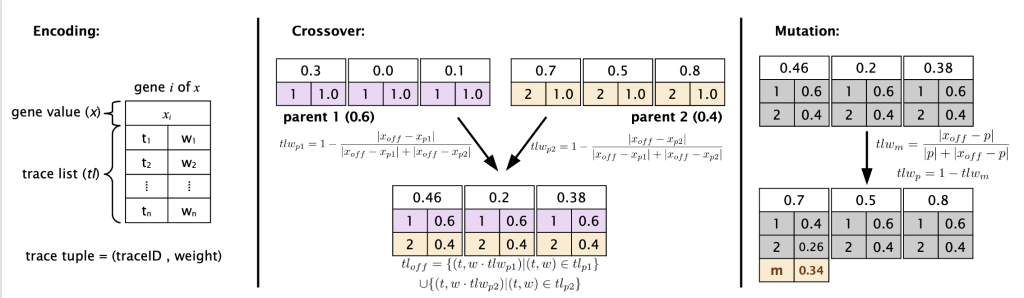
In the first part of the thesis, we discuss the algorithmic background of population dynamics research, and introduce the traceable-evolutionary algorithm (T-EA). The algorithm poses a new approach to evaluate population dynamics by tracking the heritage of each gene from the initial population to the final result. A rough overview can be seen in Figure 1. The encoding of each gene is extended by a trace list, containing historical markers that point back to the origin of the gene in the initial population. When creating new offspring individuals, these trace lists get updated alongside the gene values, keeping an accurate track of the origin of each gene. Through this flexible implementation, the T-EA can be used with all common crossover and mutation operators.
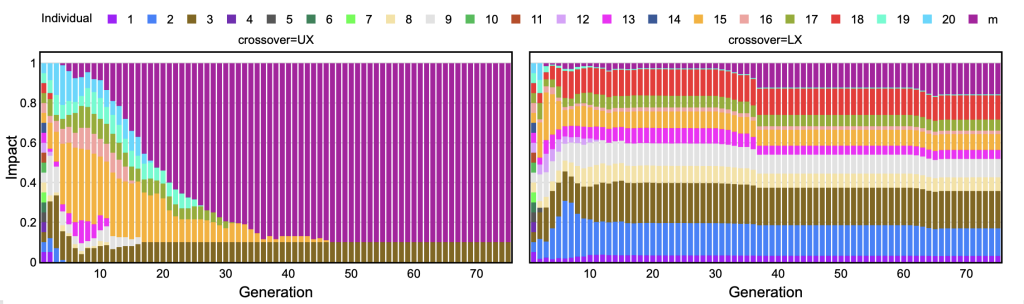
Alongside the algorithm, we also propose evaluational metrics. Most importantly, we can measure the impact of an individual of the initial population by the amount of genetic material that survived the evolutionary process.
Evaluating the Population Dynamics in Evolutionary Algorithms
Finally, we used the new algorithmic approach to evaluate the population dynamics of EAs on the gene level.
In initial exploratory evaluations, we could show differences in the population dynamics between different crossover and mutation operators. Furthermore, we could show differences in the use of genetic material for different population sizes in multi-objective EAs.
The central question of the evaluation was which individuals are influential in the search process of EAs. Here, we found differences between single- and multi-objective algorithms. For single-objective EAs, we could identify the availability of certain genetic material in the genome to be an important factor that made individuals influential in the search process, even if they did not have the best fitness. For multi-objective EAs, we could not directly show the same effects. Optimizing for more than one objective introduces additional challenges in the evaluation and changed the convergence behavior of the algorithms. Here, we could show differences in the search behavior between different algorithms and differences between the benchmark problems, mainly due to their Pareto-sets.
About the Author

Tobias Benecke is currently a visiting researcher at the University of Kent, United Kingdom. He earned his PhD summa cum laude at the Otto von Guericke University Magdeburg in 2026. In his academic journey, he worked on benchmarking and the evaluation of evolutionary algorithms. He is particularly interested in the population dynamics of evolutionary algorithms, aiming to better understand how the algorithms use their genetic material in the search process.
Journal Latest Issues


Genetic Programming and Evolvable Machines (GPEM)
Editor-in-Chief: Leonardo Trujillo
June, 2026

ACM Transactions on Evolutionary Learning and Optimization (TELO)
Editors-in-Chief: Jürgen Branke, Manuel López-Ibáñez
Volume 6, Issue 1
March, 2026
Forthcoming Events

GECCO 2026 @ San José, Costa Rica (hybrid)
The Genetic and Evolutionary Computation Conference
July 13 – 17, 2026
The Genetic and Evolutionary Computation Conference (GECCO) presents the latest high-quality results in genetic and evolutionary computation since 1999. Topics include: genetic algorithms, genetic programming, swarm intelligence, complex systems, evolutionary combinatorial optimization and metaheuristics, evolutionary machine learning, learning for evolutionary computation, evolutionary multiobjective optimization, evolutionary numerical optimization, neuroevolution, real-world applications, theory, benchmarking, reproducibility, hybrids and more.

Parallel Problem Solving From Nature (PPSN)
August 29 – September 2, 2026
The International Conference on Parallel Problem Solving From Nature (PPSN) is a biannual open forum fostering the study of natural models, iterative optimization heuristics, machine learning, and other artificial intelligence approaches. PPSN was originally designed to bring together researchers and practitioners in the field of Natural Computing, the study of computing approaches that are gleaned from natural models. Today, the conference series has evolved and welcomes works on all types of iterative optimization heuristics. Notably, we also welcome submissions on connections between search heuristics and machine learning or other artificial intelligence approaches. Submissions covering the entire spectrum of work, ranging from rigorously derived mathematical results to carefully crafted empirical studies, are invited.
About this Newsletter
SIGEVOlution is the newsletter of SIGEVO, the ACM Special Interest Group on Genetic and Evolutionary Computation. To join SIGEVO, please follow this link: [WWW].
We solicit contributions in the following categories:
Art: Are you working with Evolutionary Art? We are always looking for nice evolutionary art for the cover page of the newsletter.
Short surveys and position papers. We invite short surveys and position papers in EC and EC-related areas. We are also interested in applications of EC technologies that have solved interesting and important problems.
Software. Are you a developer of a piece of EC software, and wish to tell us about it? Then send us a short summary or a short tutorial of your software.
Lost Gems. Did you read an interesting EC paper that, in your opinion, did not receive enough attention or should be rediscovered? Then send us a page about it.
Dissertations. We invite short summaries, around a page, of theses in EC-related areas that have been recently discussed and are available online.
Meetings Reports. Did you participate in an interesting EC-related event? Would you be willing to tell us about it? Then send us a summary of the event.
Forthcoming Events. If you have an EC event you wish to announce, this is the place.
News and Announcements. Is there anything you wish to announce, such as an employment vacancy? This is the place.
Letters. If you want to ask or say something to SIGEVO members, please write us a letter!
Suggestions. If you have a suggestion about how to improve the newsletter, please send us an email.
Contributions will be reviewed by members of the newsletter board. We accept contributions in plain text, MS Word, or Latex, but do not forget to send your sources and images.
Enquiries about submissions and contributions can be emailed to gabriela.ochoa@stir.ac.uk.
All the issues of SIGEVOlution are also available online at: https://evolution.sigevo.org/.
Notice to contributing authors to SIG newsletters
As a contributing author, you retain the copyright to your article. ACM will refer all requests for republication directly to you.
By submitting your article for distribution in any newsletter of the ACM Special Interest Groups listed below, you hereby grant to ACM the following non-exclusive, perpetual, worldwide rights:
- to publish your work online or in print on the condition of acceptance by the editor
- to include the article in the ACM Digital Library and in any Digital Library-related services
- to allow users to make a personal copy of the article for noncommercial, educational, or research purposes
- to upload your video and other supplemental material to the ACM Digital Library, the ACM YouTube channel, and the SIG newsletter site.
If third-party materials were used in your published work, supplemental material, or video, make sure that you have the necessary permissions to use those third-party materials in your work.
Editor: Gabriela Ochoa
Sub-editors: James McDermott and Nadarajen Veerapen
Associate Editors: Emma Hart, Bill Langdon, Una-May O’Reilly, and Darrell Whitley